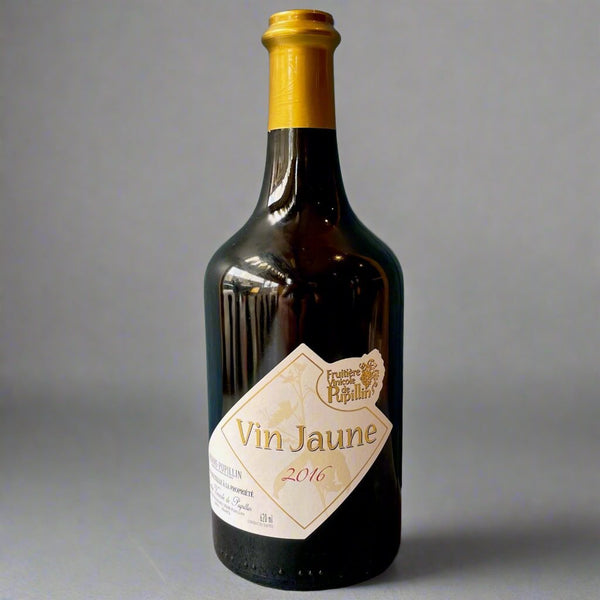

Classic Arbois‑Pupillin Vin Jaune from Savagnin, aged 6 years and 3 months sous voile and bottled in the traditional 62cl clavelin; dry, layered and spice‑led with a long finish.
Nutty, Textured, Spice
Jura / Oxidative / Savagnin / Organic
|
Farming |
Organic |
|
Producer |
Fruitiere Vinicole De Pupillin |
|
Grape |
Savagnin |
|
Wine Type |
Oxidative |
|
Country |
France |
|
Region |
Arbois AOC, Jura |
|
Vintage |
2016 |
|
Alcohol |
14.5% |
|
Size |
75cl |
Vin Jaune is made entirely from the Savagnin grape, the standout variety of the Jura vineyards. These grapes, with their firm, juicy texture and thick skins, develop a golden-bronze hue as they ripen. Nutty, spicy and wondrefully textured.
Notes on the producer
The Fruitière in Arbois was founded in 1909 by 33 farmers who united to address the severe economic challenges of the time, including national wine overproduction and high tax pressures. In the years leading up to 1910, the wine industry was in turmoil, with growers facing significant sales difficulties. This cooperative began with 23 hectares of vines, primarily as a supplementary activity to livestock breeding and cultivation in the Jura region. Initially, one-third of the Fruitière's wine production was reserved for family consumption, with the remainder sold in bulk or barrels, yielding between 50 and 250 hectolitres annually. The wines produced included both so called "ordinary" wines from Chardonnay, Savagnin, Trousseau, and Pinot Noir, as well as wines from Ploussard, and Melon grape varieties. Despite the hardships of the First World War, which reduced the cultivated area from 23 to 10 hectares, the Fruitière persisted, renting additional cellars to sustain its development through the 1930s.
In the early 1930s, the Fruitière Vinicole de Pupillin played a crucial role in the creation of the Arbois AOC, the first in France, by contributing to the committee that established local grape varieties and production criteria. The 1960s marked a significant turning point as post-war winegrowers increasingly shifted to monoculture, focusing solely on viticulture. This transition, aided by mechanisation, led to a rapid expansion of vineyard areas from 1 to 3 hectares, revitalising the Jura vineyards that had been neglected since the phylloxera crisis of the late 19th century. The Fruitière experienced substantial growth in the 1970s, surpassing 1,000 hectolitres of vinification in 1974 and expanding to 35 hectares by 1977, and 45 hectares by 1985. By the dawn of the new millennium, the estate had grown to 70 hectares, necessitating the construction of a modern vat room in 1998 to meet food standards and support further expansion beyond the village centre.